
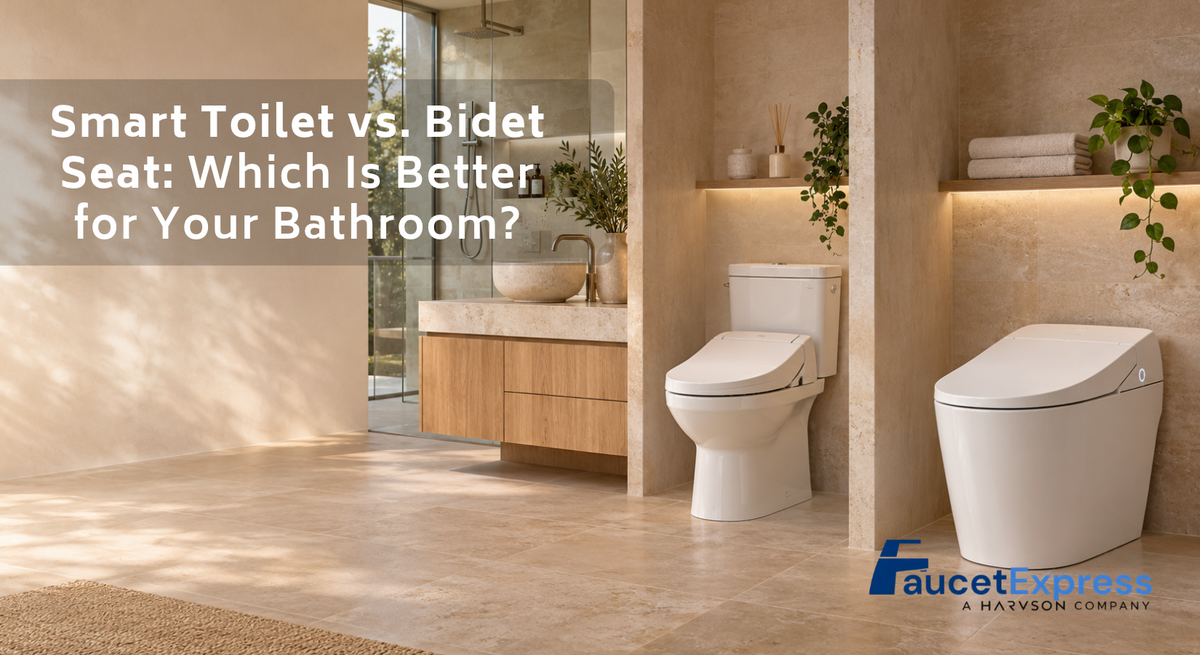
Short answer: Choose an electronic bidet seat if you already have a compatible toilet and want a premium upgrade with less disruption, lower replacement scope and the ability to keep the bowl you like. Choose a smart toilet if you are renovating or building and want the cleanest integrated design, automatic toilet functions and a complete fixture engineered as one unit. A manual bidet seat is the simplest option, but it does not provide the heated water, heated seat, dryer or electronic features found on most premium seats and smart toilets.
The right choice is not just about which product has more features. It is about what you are changing. A bidet seat upgrades the top of an existing toilet; a smart toilet replaces the toilet with an integrated system. That difference affects compatibility, electrical planning, rough-in, appearance, service, delivery and the rest of your bathroom renovation.
This guide compares smart toilets and bidet seats for Canadian homeowners, designers, builders, contractors and project buyers. It is especially useful for a primary-bathroom renovation, a new home, a luxury ensuite, a multi-bathroom order or a project where the toilet package should be coordinated with the vanity, shower and other fixtures. Product dimensions, power requirements, water connections, features and warranty terms are model-specific. Use this article to narrow the right category, then confirm the exact product with the manufacturer and installer.
FaucetExpress also has a broader intelligent-toilet guide. This article focuses specifically on the decision between an integrated smart toilet and a bidet-seat upgrade.
Smart toilet vs. bidet seat at a glance
| Decision | Integrated smart toilet | Electronic bidet seat | Manual bidet seat |
|---|---|---|---|
| What it replaces | The complete toilet fixture. | The existing toilet seat; the bowl and tank remain. | The existing toilet seat; the bowl and tank remain. |
| Bidet functions | Integrated into the toilet body. | Built into the seat; features vary by model. | Water spray using household water pressure; usually no heated water or electronics. |
| Electrical planning | Usually required for heating, sensors, controls and automatic functions. | Required for heated water, seat, dryer or electronic controls. | Normally no electrical connection. |
| Compatibility | Must fit the room’s rough-in, supply, drain and finished dimensions. | Must fit the bowl shape, mounting holes, tank clearance and water connection. | Must fit the bowl and mounting hardware; check the water connection. |
| Appearance | Most seamless and intentionally designed as one fixture. | Can be very clean when matched to the bowl, but remains a separate seat. | Usually the least integrated visually. |
| Best fit | New construction, major renovation, luxury primary bathroom and buyers who want an all-in-one system. | Existing bathrooms, targeted upgrades, renovations where the toilet bowl is staying and premium comfort matters. | Simple upgrades, rental or guest bathrooms, and projects where electricity is not planned. |
KOHLER describes the distinction directly: a smart toilet combines the toilet and bidet system in one integrated design, while a bidet seat replaces the existing seat and adds cleansing functions.[1] That scope difference should be the first decision in your project.
What is an integrated smart toilet?
An integrated smart toilet combines a toilet bowl, flushing system and electronic cleansing features in one engineered fixture. Depending on the model, it may include a heated seat, warm-water wash, adjustable spray, warm-air dryer, deodorizer, nightlight, automatic lid, automatic flush, remote control, user presets or self-cleaning functions.
Features are not universal. One smart toilet may prioritize a compact one-piece form and automatic lid; another may offer a more advanced cleansing system, a remote, a nightlight or a different flushing arrangement. Compare the exact specification sheet rather than assuming that every product advertised as “intelligent” includes the same functions.
A smart toilet is usually selected as a complete fixture. You still need to confirm the rough-in, water supply, finished projection, electrical location, service access and any required shut-off or mounting hardware. Many floor-mount smart toilets use a standard 12-inch rough-in, but the exact product controls the requirement.[2]
Browse FaucetExpress’s toilet collection for integrated intelligent toilets and complete toilet systems. The collection also includes conventional toilets and WASHLET-ready bowls, so read the complete product description and package contents carefully.
What is a bidet toilet seat?
A bidet toilet seat replaces the existing seat and adds a cleansing spray. Bidet seats are available in manual and electronic versions:
- Manual bidet seats: use water pressure and mechanical controls. They generally do not require electricity and are the simplest way to add a bidet function.
- Electronic bidet seats: use power for features such as heated water, heated seating, adjustable spray, warm-air drying, deodorizing, nightlighting, remote controls or automatic functions. Exact features vary by model.
A bidet seat does not automatically fit every toilet. The bowl shape, seat-mounting holes, tank position, seat contour, water connection and available electrical outlet all matter. TOTO’s product FAQ specifically recommends checking bowl shape, mounting-hole spacing, tank clearance and the dimensions on the selected WASHLET specification sheet.[3]
FaucetExpress carries Washlets and bidets from several product families. Start with the toilet you already own—or the bowl you plan to purchase—then verify the exact seat compatibility before checkout.
Which one is better?
Neither category is automatically better. The better choice depends on the bathroom, the stage of the project and the experience you want.
Choose an electronic bidet seat when:
- You want to upgrade an existing toilet without replacing the bowl and tank.
- The current toilet has a suitable shape, mounting layout and enough clearance for the selected seat.
- You want premium wash, heat and dryer features but do not need an integrated toilet design.
- You want the option to replace or upgrade the seat separately in the future.
- You are renovating a guest bathroom, secondary bathroom or rental where the existing toilet is staying.
- You can provide the required electrical outlet and water connection without compromising the room.
This is often the practical choice for a finished bathroom. It keeps the project scope focused on the seat, electrical and water connection. It is also a strong option when the existing toilet is a good fit and the owner cares more about cleansing and comfort than a completely integrated silhouette.
Choose an integrated smart toilet when:
- You are already replacing the toilet as part of a renovation or new build.
- You want the cleanest one-piece appearance with fewer visible connections.
- Automatic lid, automatic flush, integrated deodorizing, nightlight or more advanced controls are important to you.
- You want the toilet and cleansing system engineered as one complete fixture.
- You are creating a luxury primary bathroom where the toilet is part of the overall design package.
- You are comfortable planning power, rough-in, service access and the complete fixture cost up front.
A smart toilet makes the most sense when the wall and floor are already open or when the project is still in the specification stage. It is less attractive when the existing toilet is staying, the room has no suitable power plan or the buyer wants the lowest-disruption upgrade.
Compare the features that actually affect daily use
Long feature lists can make every premium toilet look similar. Compare the functions that change the user experience and the installation.
| Feature | Why it matters | What to verify |
|---|---|---|
| Wash modes | Determines how the cleansing spray feels and how adjustable it is. | Rear/front wash, oscillation, pulsation, spray position, pressure range and user controls. |
| Water heating | Changes comfort and may affect the seat’s power and water-planning requirements. | Tank-type or instantaneous heating, temperature range, warm-up behaviour and power specification. |
| Heated seat | Adds comfort but uses electricity and becomes part of the service scope. | Temperature settings, energy-saving mode, control method and exact power requirement. |
| Warm-air dryer | Can reduce the need for toilet paper after cleansing. | Dryer settings, airflow, temperature controls and whether it is included in the model. |
| Wand cleaning | Supports routine hygiene of the cleansing nozzle. | Self-rinse, stainless construction, sterilization or electrolyzed-water claims, and replacement parts. |
| Deodorizing | Helps manage odour while the toilet is in use. | Filter type, replacement interval and whether the feature is automatic or user-controlled. |
| Automatic lid and flush | Creates a more hands-free experience and affects the electrical and service plan. | Sensor range, manual override, flush behaviour, remote operation and power-outage operation. |
| Nightlight and presets | Improves nighttime use and allows different users to save settings. | Brightness, user memory, remote controls, side-panel controls and battery requirements. |
Premium features are only useful when the owner will use them and the project can support them. A simpler electronic seat with reliable controls may be a better purchase than an integrated model whose advanced functions are difficult to service or unnecessary for the room.
Compatibility: measure before you order a bidet seat
The most common bidet-seat mistake is shopping by toilet shape alone. “Elongated” or “round” is a starting point, not a complete compatibility check.
Record these measurements from the actual toilet:
- Front-to-back bowl length: measure from the centre of the seat-mounting holes to the front edge of the bowl.
- Mounting-hole spacing: measure centre to centre between the two seat-mounting holes.
- Tank clearance: measure from the centreline of the mounting holes to the front face of the tank or any obstruction.
- Available side space: check whether the seat’s side control panel, hose or power cord will contact a wall or vanity.
- Water connection: identify the supply location, shut-off access and whether the selected seat includes the correct junction valve or hose.
- Electrical location: confirm that the outlet is accessible and positioned according to the exact installation instructions and local requirements.
TOTO’s fit chart uses approximate reference dimensions for many WASHLET models: about 18.5 inches from the mounting holes to the front of an elongated bowl, about 16.5 inches for a round-front bowl and roughly 5.5 inches between seat-mounting holes. Some current models also require about 2 inches of tank clearance. These are reference points, not a universal approval for every brand or model.[4]
Toilet contours can also cause a problem. A seat may match the nominal bowl length but interfere where the tank meets the bowl, where the ceramic rises behind the mounting holes or where a skirted toilet uses a non-standard connection. If the bowl is not a standard shape or the dimensions are unclear, send the retailer the complete toilet model number and a photo before ordering.
WASHLET and WASHLET+ are not the same planning problem
A conventional bidet seat may connect to the toilet’s water supply with a model-specific junction valve and hose. A concealed WASHLET+ configuration is designed to work with a designated compatible toilet and can use a concealed water and power connection. TOTO distinguishes physical fit from the approved WASHLET+ combination, so do not assume that any seat can be paired with any bowl just because the outside dimensions appear close.[3]
For a clean new-build or renovation look, compare the complete bowl-and-seat combination. FaucetExpress also carries TOTO products and wall-hung toilet bowls, but the carrier, bowl, actuator and electronic seat still need to be checked as a system.
Electrical and plumbing planning
Electronic bidet seats and smart toilets both need more planning than a standard toilet. The exact requirements depend on the model.
Electrical requirements
Electronic seats normally need a nearby grounded outlet. Integrated smart toilets also require power for their electronic controls, heating, sensors and automatic functions. The electrician should review the exact voltage, frequency, wattage, outlet location, circuit and required protection before the wall is closed. KOHLER’s bidet-seat guidance specifically tells buyers to confirm that a suitable outlet is accessible, while its smart-toilet guidance identifies electricity as necessary for the integrated functions.[5]
Do not copy the electrical details from a similar-looking product. A higher-feature seat or smart toilet may have a different load, cord location or service requirement. The manufacturer’s installation guide and the local electrical authority control the final installation.
Water connection and shut-off
An electronic bidet seat commonly uses the existing toilet supply through a manufacturer-specified valve or fitting. A smart toilet has its own supply connection and may use a different inlet location or installation sequence. Confirm that the shut-off remains accessible and that the hose path will not interfere with the seat, cabinetry or service opening.
Water temperature, pressure and filtration requirements vary by model. Some seats use a small heated reservoir; others heat water as it passes through the unit. A smart toilet may use a different flushing and cleansing arrangement. Treat the product’s current installation guide as the source of truth.
Rough-in, floor and finished dimensions
A bidet seat generally keeps the existing toilet’s drain and rough-in, subject to the seat’s compatibility and the toilet’s condition. A smart toilet replaces the fixture, so verify the rough-in, supply location, footprint, finished projection, seat height and any required wall or floor clearance.
If the project uses a wall-hung smart toilet or a wall-hung bowl with an electronic seat, the carrier and concealed tank become part of the package. That is a separate planning path from a floor-mount smart toilet. Use the wall-hung toilet buying checklist before finalizing the carrier, bowl and flush control.
Installation and service: the practical trade-off
| Ownership question | Smart toilet | Electronic bidet seat |
|---|---|---|
| Installation scope | Replace the complete toilet and coordinate plumbing, electrical and finished dimensions. | Keep the existing toilet, install the seat, connect water and power, and confirm clearance. |
| Future upgrade | Usually means replacing or servicing the integrated unit. | Replace the seat while keeping the bowl if the new seat remains compatible. |
| Appearance | Designed as one fixture with integrated controls and connections. | Can be seamless with a matching bowl, but the seat remains a separate component. |
| Service planning | Coordinate access to the toilet’s electronic and plumbing components. | Maintain access to the seat, water connection, outlet and any remote or side controls. |
| Power outage | Some models retain a basic flush, while advanced functions may stop; confirm the manual. | Advanced functions may stop; confirm whether the underlying toilet still flushes normally. |
Neither option should be treated as maintenance-free. Filters, batteries, remote controls, wands, seals, cartridges, electronic boards and other parts may eventually require service. Before ordering, review the manufacturer’s warranty, parts availability and service process for the exact model. For a project with several bathrooms, record the model and installation guide for every room so future service is easier.
Which choice makes sense for a renovation project?
For one bathroom, choose based on the existing toilet and the desired design. For several bathrooms, do not assume that every room needs the same level of technology.
| Project situation | Practical starting point | Why |
|---|---|---|
| Existing toilet is staying | Compatible electronic bidet seat. | Adds premium comfort without replacing a suitable bowl and tank. |
| Primary bathroom renovation | Compare an integrated smart toilet against a premium seat-and-bowl package. | The room is already open to electrical and plumbing planning, and appearance matters more. |
| New home or full-house project | Use a room-by-room technology plan: smart toilet in the primary suite, seats or standard toilets elsewhere. | Matches the feature level to the room while keeping quantities and service consistent. |
| Guest, rental or secondary bathroom | Manual seat, electronic seat or standard toilet depending on the owner’s priorities. | Lower complexity and easier future replacement may matter more than maximum features. |
| Wall-hung toilet design | Plan carrier, bowl, actuator and electronic seat together. | The concealed system determines compatibility, access, finished height and service. |
For a higher-value project, a mixed package can be the most sensible answer. A primary bathroom may justify an integrated smart toilet, while secondary bathrooms use compatible electronic seats or standard toilets. That gives the buyer a stronger experience where it matters without forcing one expensive specification into every room.
If the toilet decision is part of a wider renovation, use the bathroom renovation fixture checklist to coordinate the toilet with the shower system, tub, vanity, faucet, accessories, electrical work and delivery schedule.
Cost and ownership: compare the complete scope
Do not compare the price of a seat with the price of a smart toilet as if they are the same purchase. The seat may be only one line added to an existing toilet. The smart toilet replaces the complete fixture and may change the electrical, plumbing and installation scope.
| Cost or effort category | Bidet seat | Smart toilet |
|---|---|---|
| Fixture scope | Seat plus any required valve, hose, outlet or accessory. | Complete toilet plus any required supply, outlet, controls or installation accessories. |
| Existing toilet | Usually retained if compatible and in good condition. | Replaced, so removal and disposal may be part of the project. |
| Electrical work | Required for electronic models; not normally required for manual seats. | Usually required and may be planned alongside the complete fixture. |
| Installation labour | Often narrower in scope, but the exact seat and toilet still control the work. | May involve full toilet installation, floor and rough-in checks, electrical coordination and service planning. |
| Future service | Seat can often be replaced independently if the bowl remains compatible. | Integrated components are part of one fixture and need model-specific parts or service. |
For a quote, give the retailer the complete scope: toilet model, seat or smart-toilet model, room, rough-in, electrical status, delivery postal code, installer date and any preferred finish or design requirements. That produces a more useful answer than asking for the price of “a smart toilet” without the project details.
Common mistakes to avoid
- Buying by shape alone: elongated or round does not confirm mounting holes, tank clearance or the bowl contour.
- Assuming every electronic seat fits every toilet: read the compatibility chart and measure the actual bowl.
- Forgetting power: an electronic seat or smart toilet needs early electrical planning.
- Assuming the toilet rough-in is universal: confirm the exact smart-toilet rough-in, supply and finished projection.
- Confusing a WASHLET with a WASHLET+ system: concealed connections may require a designated bowl and seat combination.
- Ignoring the existing toilet’s age or condition: a premium seat may not be the right investment if the bowl, tank or rough-in also needs replacement.
- Ordering an integrated toilet without service planning: confirm access, controls, shut-off and the manufacturer’s service process.
- Comparing only the fixture price: include removal, installation, electrical work, delivery and any required rough-in accessories.
- Choosing the same technology for every bathroom automatically: match the package to each room’s purpose and project budget.
- Leaving the model decision until after the wall is closed: the exact product should be known before electrical and plumbing locations are finalized.
Smart toilet and bidet-seat buying worksheet
Before requesting a quote or placing an order, record:
- Room and project type: existing bathroom, renovation, new home, multi-unit or commercial.
- Current toilet brand and complete model number, if keeping the bowl.
- Bowl shape, mounting-hole spacing, front-to-back measurement and tank clearance.
- Rough-in measurement, supply location, finished floor height and available side clearance.
- Desired features: wash modes, water heating, heated seat, dryer, deodorizer, nightlight, auto lid, auto flush and remote.
- Electrical status: outlet location, voltage, circuit and local installation review.
- Water connection, shut-off access and service clearance.
- Exact product model, finish, package contents, warranty and parts support.
- Required-on-site date, delivery postal code and whether the order should be staged with other bathroom fixtures.
Frequently asked questions
Is a smart toilet the same as a bidet toilet seat?
No. A smart toilet is a complete toilet with integrated electronic cleansing and other functions. A bidet seat replaces the existing seat and adds cleansing features to a compatible bowl. An electronic bidet seat can provide a premium experience, but it remains a separate component.
Is a bidet seat cheaper than a smart toilet?
Often, yes, because the seat can keep a suitable existing toilet and usually has a narrower replacement scope. The complete project cost still depends on the exact model, electrical work, installation, delivery and whether the toilet needs replacement anyway.
Do all bidet seats require electricity?
No. Manual bidet seats generally use water pressure and do not use electricity. Electronic seats require power for features such as heated water, heated seating, dryer, deodorizer or electronic controls. Confirm the exact model before ordering.
Will a bidet seat fit my existing toilet?
It may, but you must confirm the bowl shape, mounting-hole spacing, front-to-back length, tank clearance, ceramic contour, water connection and electrical access. Send the complete toilet model number and measurements if the fit is uncertain.
Can I install a bidet seat on a non-TOTO toilet?
Many seats can fit non-brand bowls when the measurements and connections match. TOTO specifically says compatibility depends on bowl shape, mounting dimensions, tank clearance, water connection and electrical access. A concealed WASHLET+ combination has additional designated compatibility requirements.[6]
Do smart toilets need a special rough-in?
Many floor-mount models use a standard 12-inch rough-in, but this is not a universal approval. Confirm the exact rough-in, supply location, finished dimensions and installation guide for the selected model. Wall-hung smart configurations also require a compatible carrier system.
What happens if the power goes out?
Behaviour varies by model. Some smart toilets retain a basic manual flush, while electronic cleansing, heating, sensors or automatic functions may be unavailable. Check the manufacturer’s instructions before buying if outage operation is important to you.
Should I choose a smart toilet for every bathroom in a new home?
Not necessarily. A mixed specification is often more practical: an integrated smart toilet in the primary ensuite, electronic seats or standard toilets in secondary rooms, and a coordinated fixture schedule for the entire home. The right package depends on use, budget, service expectations and the electrical plan.
Can FaucetExpress help compare a smart toilet and bidet-seat package?
Yes. Send the current toilet model or renovation plans, preferred features, rough-in and electrical details, delivery postal code and project timing. FaucetExpress can help identify compatible products, compare the complete scope and prepare a quote. The installer should approve the final fit and installation requirements.
Plan the right toilet package with FaucetExpress
The best choice is the one that matches the bathroom you are actually building. An electronic bidet seat is usually the efficient upgrade when a suitable toilet is already installed. An integrated smart toilet is usually the stronger design choice when the project already includes a new toilet, electrical planning and a premium fixture package.
Start with FaucetExpress’s Washlets and bidets and toilet collection. For a single-bathroom compatibility question, contact our support team with the exact toilet model and measurements. If the order is part of a renovation, new home, multi-bathroom package or commercial project, send us the room schedule, exact models, installer notes, delivery postal code and required-on-site date through our bulk-orders page. We can help turn the smart-toilet decision into a complete, coordinated order.
Technical references
- KOHLER: Smart Toilets. Used for the distinction between integrated smart toilets and bidet seats, electricity, rough-in and feature-planning examples.
- KOHLER: Bidet Toilet Seats. Used for manual versus electric seat planning, bowl compatibility and electrical-access guidance.
- TOTO: Product FAQ. Used for WASHLET bowl shape, mounting-hole, tank-clearance and non-TOTO compatibility guidance.
- TOTO: WASHLET Installation Requirements Fit Chart. Used for the approximate measurement examples and the warning that bowl contours can affect fit.
- TOTO: Will a WASHLET Fit a Non-TOTO Toilet?. Used for the compatibility checklist and the distinction between physical fit and approved combinations.
- KOHLER: Smart Toilets — Advanced Hygiene, Design & Comfort. Used for the model-specific standard-rough-in and feature examples.
Technical references and product pages were checked November 9, 2026. Recheck the exact manufacturer instructions, compatibility charts, product URLs, package contents, availability, warranty and local electrical requirements immediately before publishing and ordering.